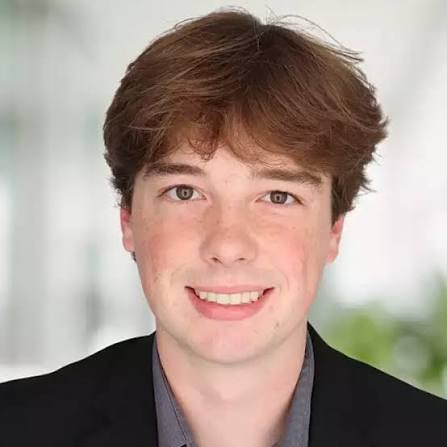
The idea that an undiscovered organism could one day change the world is what first drew Spencer Schaberg ’28, a junior in the College of Arts and Sciences at Indiana University Bloomington, to the Microbiology program. That curiosity quickly became an opportunity to contribute to scientific discovery through undergraduate research.
I came to IU knowing I wanted to study microbiology, so my decision was really about finding a place that could support that interest and get me involved in research as early as possible,” he said. “The College had more than just a standout microbiology program, it also had the faculty and resources that would allow me to dive into real academic research from the very beginning.”
That opportunity arrived before he had even attended his first class.
The summer before transferring to IU from the University of Florida, Schaberg contacted microbiologist Professor Daniel Kearns and expressed interest in joining his laboratory. Kearns welcomed him into the lab as an undergraduate researcher, giving him a head start that would shape nearly every aspect of his college experience.
Schaberg conducted research focused on the swarming motility of Bacillus subtilis, a form of bacterial movement that may play a role in resistance to certain antibiotics. While the scientific questions are complex, Schaberg said the appeal of microbiology has always been rooted in the extraordinary influence microbes have on the world around us.
“I’m drawn to microbiology specifically because of how it permeates nearly every aspect of our lives, whether we know it or not,” he said. “Microbes shape our food, medicine, agriculture, and industry, though we still know so little about the scope of their diversity.”
That sense of possibility continues to motivate his work.
“In fact, the overwhelming majority of microbes are still unculturable, present in the environment but yet to be grown in the lab,” Schaberg said. “That was the pull for me, the idea that somewhere, an organism capable of changing the world is waiting to be discovered.”
For Schaberg, the classroom has helped place those ambitions in a broader context.
One course, M250 Microbiology, remains among the most influential experiences of his academic career. The class introduced him to the astonishing adaptability of microorganisms and the vital role they have played in some of science’s most important advancements.
“The M250 microbiology lecture I took in my first year remains the most interesting course I’ve ever taken because it opened my eyes to how ubiquitous and specialized microorganisms are,” he explained.
Microorganisms have evolved to thrive in environments once thought inhospitable to life, from environments as varied as Yellowstone’s hot springs, to nuclear waste sites. Learning about those adaptations reinforced his conviction that studying microbes offers one of the most promising avenues for scientific discovery.
Outside the classroom, as an undergraduate researcher in the Kearns laboratory, Schaberg gained experience designing experiments, analyzing data, and contributing to the development of an independent scientific project.
“To me, the value of my research goes beyond just understanding and developing experimental techniques,” he noted. “Getting to take responsibility, at least in part, for the development of an independent research project is a priceless experience for my future career goals.”
That foundation led to another transformative opportunity this past summer.
Supported by the Lawrence M. Blatt Biotechnology Scholarship, available through the College’s Walter Center for Career Achievement, Schaberg completed an internship at Triangulum Biosciences, a biotechnology startup. During the internship, he cultured microorganisms collected from the environment and isolated a strain of Kluyveromyces lactis from a berry bush in his own backyard. He then sequenced and analyzed the organism’s genome using bioinformatics tools.
“Thanks to this scholarship, I learned a lot about biotechnology, which aligns closely with my plans for after university. Apart from what I learned, I built a lot of good relationships, solidified my desire for graduate school, and enjoyed myself the whole time. This gift made it possible for me to gain a wealth of experience, and it’s the experience that made me want to continue doing exactly that kind of work.”
Schaberg’s growth at the College and IU Bloomington has extended beyond laboratories and internships.
For example, as a science opinion writer for the Indiana Daily Student, he has explored topics ranging from botany and astronomy, to archaeology and the public’s understanding of science. This experience has strengthened his ability to communicate complex ideas clearly and accurately, a skill he believes is critical for researchers seeking grants, support, and public engagement.
Schaberg has also served on the leadership board of the Indiana University Journal of Undergraduate Research, represented students in congressional governance, worked as an Organic Chemistry Undergraduate Teaching Intern (UTIN), and recently began his senior thesis research.
“My time at IU so far, from swarming motility research to isolating a wild yeast species from my own backyard, has shown me that the answers to some of biology’s most important open questions aren’t necessarily hiding in some far-off, exotic environment,” he said. “They can be found nearly everywhere if you’re willing to go look for them.