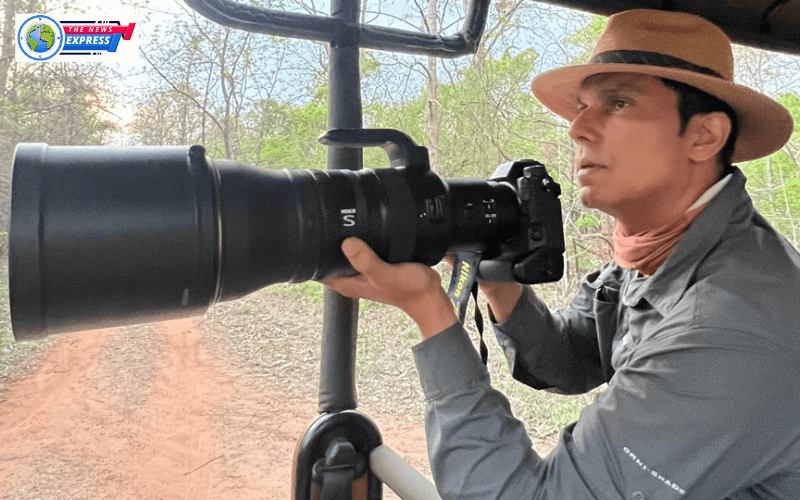
For actor Randeep Hooda, photography has been a passion for years. It’s an excuse to head to the jungles which he loves to the core. On World Photography Day today, which falls ahead of his 50th birthday, the actor sums it up, “I am more comfortable behind a still camera than I am in front of a still camera.”
The actor, who won the Best Debut Director at the National Film Awards for his film Swatantrya Veer Savarkar, confesses that his passion helped him on both personal and professional fronts.
“The camera helped me a lot in my direction. The compositions which I experimented with my still camera helped me a lot in framing the film shots. From how to bring attention to a certain part of the frame and how to make an aesthetic frame, all that made my choices a bit easier,” he says but credits his director of photography Arvind Krishna as well.
“So with my sense of framing and his expertise, I was able to capture my movie well. Most actors when they become directors, they’re directing other things and not the frames. When I became a director, I already knew that I had experimented with a lot of frames. And, it all started with a still camera.”
How camera became his muse
Randeep’s love for photography started with humble camera phones and then he started admiring photos in magazines and on Instagram.
“Without the camera, I used to go to jungles and enjoy the beauty. Then I bought a camera but so many buttons on it that it discouraged me from even using it. So, I started experimenting from my balcony in Mumbai.”
His turning point was connecting with wildlife photographer Sarosh Lodhi whom he admired.
“So, we interacted on Instagram messages and he said, well why don’t you come to Nagpur and we’ll go to Kanha National Park (Madhya Pradesh), and I’ll show you how to use it. That just happened at about 9pm and at 6am I was at Nagpur airport with a couple of friends, and that’s how it all began. There, I saw my first tiger Chota Munna and I got great pictures in my first 2-3 outings, and then I was hooked. Then, the camera became a very big excuse to be in the jungle.” He then started documenting his trips and clicks as “every frame has a story to tell”.
Photography is now democratic
The actor says that with a mobile in every hand, “photography has become more democratic.”
He says, “It is not just for the privileged few which is a very good thing. Everybody gets to capture what they like, but also the value of the photographs has become lesser because it’s so readily available to everybody. The reverence of that one superbly framed shot has become lesser because you have the option to click multiple pix.”
Personally, he likes clicking less and framing more. “I enjoy it most in the wild. I am absolutely not a tiger crazy that a lot of people are. I like landscapes, all different birds, all kinds of animals and its setting. I don’t try to go too close for portrait shots and try to capture the habitat with it,” he says.