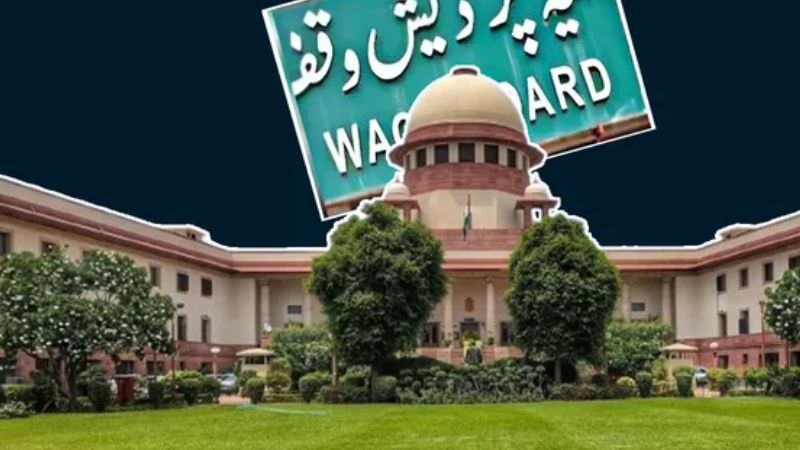
The Supreme Court is hearing today a batch of petitions challenging the constitutional validity of the Waqf (Amendment) Act, 2025, and will consider whether to grant an interim stay on its provisions.
Commencing arguments on behalf of the petitioners, senior advocate Kapil Sibal apprised a Bench comprising Chief Justice B.R. Gavai and Justice Augustine George Masih that the contentious law constitutes a “creeping acquisition” of waqf properties by the Centre, thereby infringing upon the right of Muslims to manage their religious affairs.
He further contended that the 2025 amendments constitute a fundamental departure from the well-established framework of waqf legislation developed over several decades.
Also Read: Will the Waqf law usher in transparency?
Earlier in the proceedings, Solicitor General Tushar Mehta, representing the Union government, submitted that the court could first deliberate on three specific concerns—whether properties declared as waqf by courts can be denotified, the legality of waqf-by-user, and waqf-by-deed—before proceeding to wider questions around the law.
However, the petitioners vehemently opposed this approach, contending that the case involves fundamental constitutional questions that cannot be resolved in a “piecemeal” manner.
The Centre had notified the Waqf (Amendment) Act, 2025 last month, following President Droupadi Murmu’s assent on April 5. The Bill was passed in the Lok Sabha with 288 members in favour and 232 against. In the Rajya Sabha, 128 members voted in favour, while 95 opposed it.
- The 2025 amendments pave way for waqfs to lose their character with retrospective effect: Sibal
Mr. Sibal argues that the 2025 amendments pave the way for waqf properties to lose their status with retrospective effect.
“How will we know the creator of a waqf-by-user that dates back hundreds of years, even if it is registered?” he asks. “Where do we find the records for such dedications?”
He adds that under the amendments, if a muthawalli (manager of a waqf) cannot name the original creator of the waqf, they could face six months’ imprisonment and a fine.