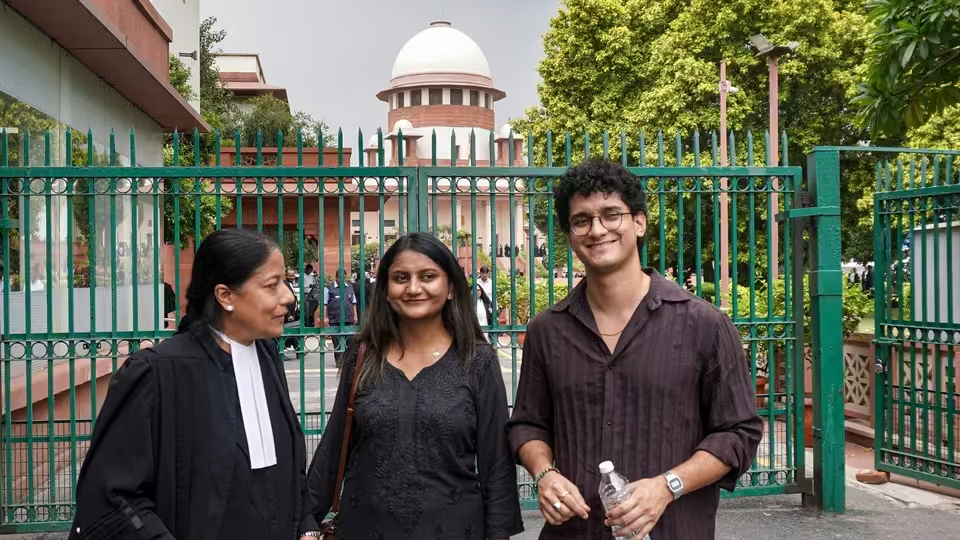
The Supreme Court on Monday declined to interfere with the proposed September 5 protest march in Delhi by the Cockroach Janta Party (CJP), saying it was for the Centre and Delhi governments to take a call on law-and-order arrangements and stressing that all stakeholders were expected to act peacefully and within the legal framework.
A bench, comprising Chief Justice of India Surya Kant and justices Joymalya Bagchi and V Mohana, said that there were “no compelling circumstances” before it to presume that the proposed mobilisation would turn violent, while leaving it to the authorities to decide whether the march could be held and under what conditions.
“We have no reason to doubt that everyone will behave in a peaceful and lawful manner…As of now, there are no compelling circumstances before us to presume or assume anything otherwise,” said the bench
“We are confident that everyone will follow the law, regulatory measures and they will also respect each other’s right — whether fundamental rights or statutory rights under the existing legal framework,” the bench added.
The court was hearing pleas filed by Shivam Upadhyay and retired Delhi police officer Rajendra Singh seeking restrictions on large-scale mobilisation, marches and organised demonstrations in security-sensitive areas of Lutyens’ Delhi, including India Gate and Central Vista.
The plea, filed through advocate Pulkit Agarwal, also sought postponement or modification of the proposed September 5 march until after the BRICS Summit scheduled to be held in Delhi on September 12 and 13.
Appearing for Singh, advocate Rizwan Ahmad argued that the organisers announced another march despite not having obtained police permission. “How can again they announce a similar march for September 5? They have no permission. These things lead to lawlessness,” Ahmad submitted.
He urged the court to defer the proposed mobilisation until after the BRICS Summit, pointing out that any untoward incident in Delhi in the run-up to the international gathering could attract global attention.
“They have tasted blood and if there is any violence, even a small lathi charge, international media is going to broadcast it and the issue will be highlighted,” Ahmad said.
The bench, however, declined to enter into the issue, making a distinction between questions of law and order and issues falling within the court’s judicial domain. “This has to be considered in some other quarter. It is not for us to intervene,” it stressed.
The court made clear that the responsibility for maintaining law and order rested with the Centre and the Delhi government. “These are the issues to be considered by the law-and-order authority. It is for that authority to say what is legal and what is illegal. We expect both sides will act in accordance with the legal framework and will act in a lawful and reasonable manner,” the bench said.
When Ahmad sought an assurance that he be allowed to approach the court on September 3 or 4 if the organisers had still not sought permission, the bench said that the matter could be brought before it if any alarming or untoward situation arose, provided it involved an issue within the court’s core judicial domain.
“If any untoward incident happens, you can always come to us…if something alarming is happening, also provided the issue falls in the core judicial domain, you can mention before us on any day,” it said.
The court also rejected a request to summon representatives of the CJP, pointing out that there was no identified or organised entity before it that could be asked to appear. “There is no organised or identified group before us that we can request to appear before us,” the bench said.
“It is for the government of Delhi and India to act. That is why we are saying serve the copies on the governments,” it added.
The proposed September 5 march was announced by the CJP on August 24 as a “peaceful march” from India Gate to the Delhi police headquarters. The mobilisation is being led by families of students who died by suicide following the cancellation of the National Eligibility cum Entrance Test (NEET) examination and its subsequent re-test, as well as those alleging police excesses during the July 20 agitation.
The march is aimed at protesting what the group alleges was the Centre’s failure to honour assurances given on July 25 that had led to the withdrawal of its 36-day agitation at Jantar
The All India Students’ Association (AISA) extended support to the proposed three-kilometre march and backed demands for withdrawal of FIRs against student protesters and an inquiry into allegations of pellet and bullet firing during the earlier demonstrations.
The Supreme Court’s refusal to intervene comes as a five-member high-powered enquiry committee (HPEC), headed by former Supreme Court judge Justice R Subhash Reddy, is preparing to examine the competing allegations arising from the July 20 protest.
The bench on Monday directed that the petition be served on the Centre and Delhi governments and posted it along with the connected matter for September 10, with the petitions also to be served on the HPEC.
The HPEC was constituted by the Supreme Court on August 18 after the court found that allegations of excessive use of force during the July 20 protest prima facie warranted an independent and impartial inquiry.
The committee was tasked with examining not only allegations of police excesses but also claims of violence by protesters, injuries caused to police personnel and damage to public property.
The panel, headed by Justice (retired) R Subhash Reddy, includes Justice (retired) Ravi Shankar Jha, former chief justice of the Punjab and Haryana high court; Justice (retired) Shalinder Kaur, former Delhi high court judge; former CBI director Rishi Kumar Shukla; and retired Meghalaya DGP LR Bishnoi.
The committee was asked to examine allegations concerning the use of pellet guns, electric batons, lathis and tear gas, the proportionality of police action, blanket prohibitory orders, surveillance of protesters and the invocation of section 152 of the Bharatiya Nyaya Sanhita. Its mandate also covers allegations of targeted violence, harassment and molestation of women protesters, besides the medical and other assistance provided to victims and the possibility of interim compensation.
The panel is directed to preserve and examine CCTV and drone footage, body-worn camera recordings, videography, wireless communication records and PCR call logs relating to the protests. It can receive documentary evidence and representations from affected persons and permit anonymous complaints to protect complainants and witnesses.
On Monday, Upadhyay’s lawyer sought a comprehensive investigation into the July 20 events, including the alleged unlawful assembly, injuries to police personnel and damage to government and public property. He also sought directions to ensure implementation of statutory safeguards available to police officers dealing with unlawful assemblies.
The bench, however, directed him towards the HPEC. “We have already set up a high-powered committee where you can go and submit your representations or suggestions. We can issue further directions only after we receive their recommendations,” said the bench, describing the committee as a “neutral umpire” that would examine all pertinent issues and make recommendations to the court.
The court repeatedly made clear that the HPEC’s inquiry will remain under its supervision.
Last week, when petitioners sought reconstitution of the panel and a wider probe into the alleged role of Union home minister Amit Shah, Delhi police commissioner Anurag Kumar and other senior officials, the CJI said that the committee will function under the court’s direct supervision.
“Whosoever will work, they will work under the direct supervision of this court. We have not disposed of the matter and will monitor everything,” CJI Kant had said.
The petitioners sought a wider probe into the chain of command and alleged instructions concerning use of force during the July 20 protest, including allegations relating to pellet guns, electric batons and alleged planting of evidence at protest sites.
The Centre and Delhi government maintained that they have no objection to an independent and fair inquiry while denying allegations of police excesses.