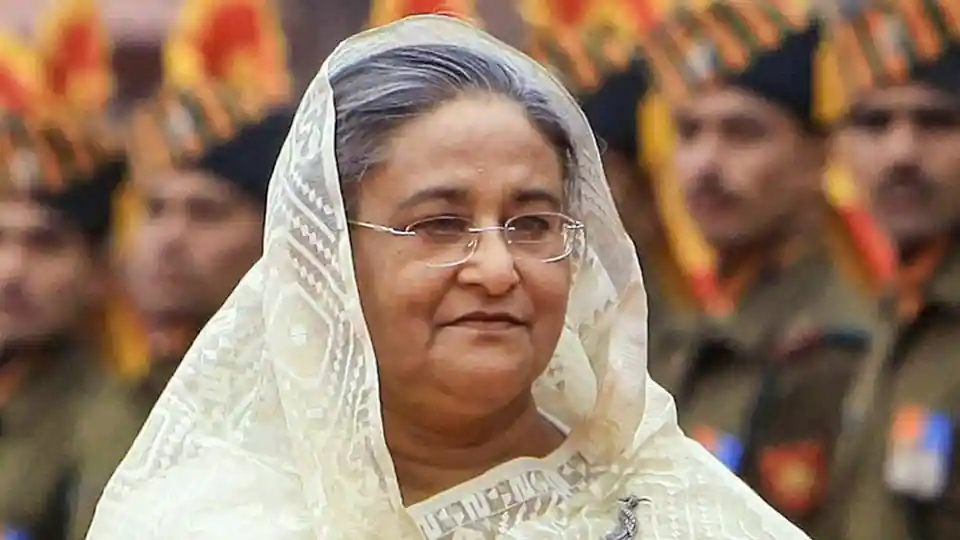
Former prime minister Sheikh Hasina on Monday sought a new passport and national identity card from the Bangladesh high commission in New Delhi to facilitate her planned return home from self-exile in India in December, a move dismissed hours later by Dhaka, which reiterated its demand for her extradition.
Hasina, 79, has lived in India since her government was ousted in a student-led uprising in August 2024. She has insisted in several interviews, including with HT, that she intends to return to Bangladesh in December despite being sentenced to death over her government’s crackdown on protesters.
The former premier confirmed to HT that her London-based lawyers had written to the Bangladesh high commission seeking a new passport and national identity card, and shared a copy of the letter emailed to the mission on Monday. The request marks the clearest step by Hasina so far to act on her plan to return to Bangladesh.
“In view of the reported revocation of her existing Bangladeshi passport and National Identity Card (NID) by the Interim Government and other authorities, I respectfully request that you take the necessary steps to issue a new Bangladeshi passport and National Identity Card for our client,” Hasina’s lawyers at Matrix Chambers in London wrote to Preeti Rahman, the acting high commissioner at the Bangladeshi mission.
“Our request is made on the basis of her Bangladeshi nationality in accordance with any obligations arising under the laws of Bangladesh as well as any applicable obligations arising under international human rights instruments,” the letter said. It asked the mission to provide details of formalities and documentation “required to expeditiously process the applications”.
Bangladesh’s minister of state for foreign affairs Humaiun Kobir said in Dhaka hours later that his government will insist on the extradition of Hasina, whom he described as a “killer and terrorist” who fled the country after allegedly killing more than 2,000 people. “There is a process for her return – the extradition treaty [between India and Bangladesh]. She can ask India to hand her over through the extradition treaty,” he told reporters.
“Let her come back, surrender before the court and serve her sentence,” Kobir said, noting that she had been sentenced to death in one case and many other cases are pending. “Bangladesh does not give passports to terrorists. It asks for them to be handed over.”
Kobir also described Hasina’s application as weak “from a legal, ethical and moral point of view”.
There was no immediate word on the development from India’s external affairs ministry.
Hasina’s move appeared to be aimed at drawing a distinction between her plan to return to Bangladesh of her own volition and Dhaka’s repeated calls for her extradition so that she can face charges at home, people familiar with the matter said on condition of anonymity. They said the proposal to seek a new passport had been in the pipeline for some time.
Possession of a passport will also allow Hasina to have a greater say in the method of her return, the people said. “If you have a passport, you can choose to enter via a land border crossing. If it’s an airport, the aircraft and the facility can be secured and the person taken away quickly. It will be much tougher to do that at a land border crossing,” a person said.
Hasina, who has said in the past that she intends to surrender to a court on returning to Bangladesh, is expected to announce the date for her homecoming after various formalities are completed, the people said.
In 2025, Bangladesh’s International Crimes Tribunal sentenced her to death for crimes against humanity on the grounds that she was responsible for ordering a crackdown on student-led protests that left hundreds dead and thousands injured. The UN said in a report that nearly 1,400 people were killed. Hasina denies any wrongdoing and has rejected the tribunal’s verdict and challenged the legitimacy of her trial.
The Indian side has responded to Bangladesh’s repeated calls for Hasina’s extradition by saying the request is being examined in line with legalities and judicial processes. Bangladesh has also insisted that her extradition is imperative for creating an environment conducive to advancing bilateral ties.