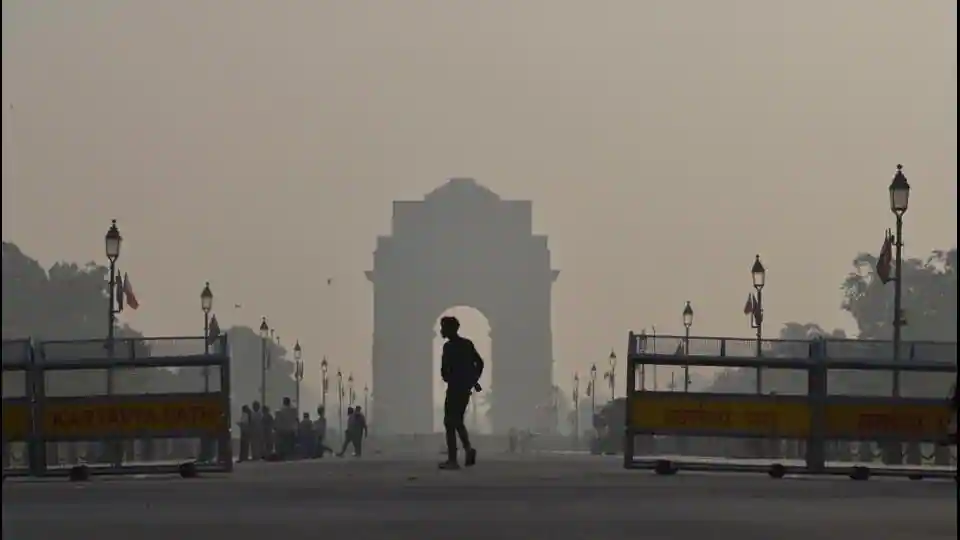
Delhi’s air quality improved to the moderate category on Saturday morning, with the Air Quality Index (AQI) falling to 185, a day after it remained in the poor category at 230, even as minimum temperatures dropped across all five weather stations in the Capital.
The Capital’s AQI stood at 185 at 9.05 am, according to data from the Central Pollution Control Board (CPCB). The hourly AQI was recorded at 201 at 4 am before improving marginally to 197 at 5 am, according to data analysed by HT. It continued to decline in subsequent hourly readings.
Delhi’s air quality remained largely in the moderate category through October, with brief improvements on October 12 and 16 following rainfall. The AQI stood at 187 on October 18, fell to 139 on October 19 and rose to 179 on October 20. The Capital recorded its first poor air quality reading of the season on October 21, when the AQI climbed to 245.
On Friday, Delhi’s AQI rose seven points to 230 in the CPCB’s 4 pm bulletin, compared with 223 on Thursday, remaining in the poor category. However, the seven-day average through October 23 stood at 195, the third-lowest average for the corresponding period in the 12-year period from 2015 to 2026.
Meanwhile, NASA satellite data detected 545 farm fires in Punjab and Haryana between October 1 and 23, including 473 in Punjab and 72 in Haryana. Of these, 50 were recorded on October 23. During the corresponding period last year, the satellite detected 708 farm fires.
According to the Central Pollution Control Board (CPCB), an AQI of 0–50 is classified as good, 51–100 as satisfactory, 101–200 as moderate, 201–300 as poor, 301–400 as very poor and 401–500 as severe.
Data from 58 of Delhi’s 59 air quality monitoring stations showed that 24 recorded poor air quality, while the remaining stations reported moderate levels. At 6 am, the CPCB listed PM2.5 as the main pollutant at 39 of Delhi’s 58 reporting stations and PM10 at 18. At the same hour a day earlier, the counts were 44 and 13, respectively, out of 57 stations.
Delhi’s minimum temperature fell across all five weather stations over the 24 hours ending on Saturday, with Ayanagar recording the lowest temperature at 17 degrees Celsius, according to India Meteorological Department (IMD) data.
The minimum temperature at Ayanagar fell by 2.1 degrees Celsius in the past 24 hours to settle at 17 degrees Celsius, the sharpest decline among the five stations. Safdarjung and Palam recorded minimum temperatures of 18.3 degrees Celsius and 17.6 degrees Celsius, respectively.
Lodhi Road recorded a minimum temperature of 17.6 degrees Celsius, while the Ridge station registered 18.4 degrees Celsius, the highest among the five stations.
The minimum temperature at Safdarjung was 1.1 degrees Celsius above normal, while Lodhi Road recorded a departure of 1.6 degrees Celsius above normal. At Palam and Ayanagar, the minimum temperatures were 0.2 degrees Celsius below normal. The Ridge station recorded a minimum temperature 0.1 degrees Celsius below normal.
The 24-hour change in minimum temperature showed a decline of 0.7 degrees Celsius at both Safdarjung and Palam, while Lodhi Road and the Ridge recorded falls of 1 degree Celsius and 0.8 degrees Celsius, respectively.
No rainfall was recorded at any of the five stations during the 24 hours ending at 8.30 am on Saturday.