Gujarat high court on Tuesday upheld the special court’s 2022 order sentencing 38 convicts to death and 11 others to life imprisonment in the 2008 Ahmedabad serial blasts, which claimed 56 lives and injured 246 persons.
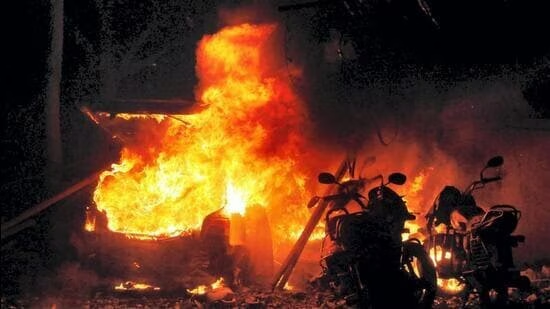
On July 26, 2008, a series of 21 bomb blasts took place across 20 locations in Ahmedabad within a span of 70 minutes. Two days later, live bombs were recovered from Surat. The city crime branch named more than 100 persons as accused, while 78 were put on trial.
A division bench of Justice A.Y. Kogje and Justice S.J. Dave heard appeals against the 7,015-page special court judgment and the state government’s plea seeking confirmation of the death sentences awarded to the 38 convicts.
The trial was conducted by clubbing 35 cases, including 20 first information reports (FIRs) registered in Ahmedabad relating to the blasts and 15 in Surat where the bombs failed to explode. The convicts were found guilty under the Indian Penal Code, the Unlawful Activities (Prevention) Act, the Explosive Substances Act and the Prevention of Damage to Public Property Act.
The prosecution examined 1,163 witnesses during the trial, which nine judges heard over the years. The identities of 26 key witnesses were kept confidential for security reasons.
The high court also directed the Gujarat government to pay compensation of ₹10 lakh to the families of those killed, ₹5 lakh to victims who suffered grievous injuries and ₹1 lakh to those who sustained simple injuries. The compensation has to be paid by March 31, 2027.
The compensation is substantially higher than the amounts awarded by the special court in 2022, which had fixed it at ₹1 lakh for each death, ₹50,000 for grievous injuries and ₹25,000 for simple injuries.
On February 8, 2022, a special court convicted 49 accused and acquitted 28 others.
Those acquitted included Mubin Shaikh and Mansur Pirbhoy, who had been accused of conspiring in the attacks and sending emails claiming the attacks were carried out in revenge for the 2002 post-Godhra violence in Gujarat.
One accused was granted pardon after turning approver, while four other approvers who later retracted their statements were convicted.
The 49 convicts, including former Students Islamic Movement of India (SIMI) chief Safdar Nagori and his associates from 11 states, including Gujarat, Madhya Pradesh, Kerala and Uttar Pradesh, were held guilty for their role in the conspiracy behind the blasts. The prosecution alleged that the accused regrouped under the banner of the Indian Mujahideen.
The blasts marked the first terror attack in India in which hospitals were targeted. The special court’s 2022 order also marked the first time an Indian court awarded the death penalty to as many as 38 convicts in a single case.